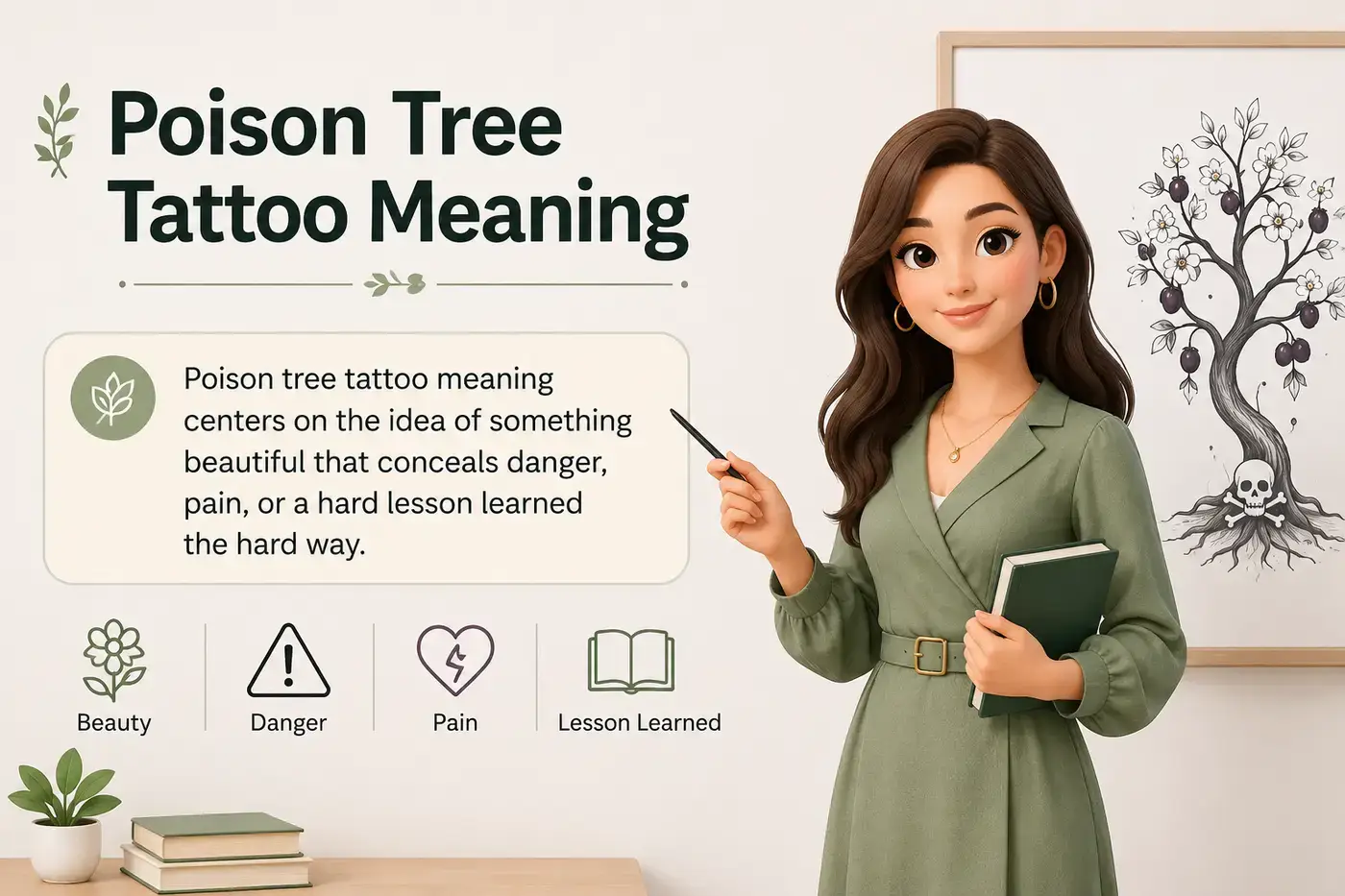
Poison tree tattoo meaning centers on the idea of something beautiful that conceals danger, pain, or a hard lesson learned the hard way. It is a design that looks striking on its own, but almost everyone who gets one is telling a story underneath the ink. The tree itself can be drawn in countless styles, twisted branches, dark roots, glowing fruit, but the symbolism stays rooted in contrast.
At its core, this tattoo plays with the gap between appearance and reality. Something that looks inviting can still be harmful. That single idea gives the design enormous flexibility, which is part of why it shows up across so many different tattoo styles and personal stories.
For some people, the meaning is deeply personal: a relationship, a betrayal, a battle with mental health, or a moment of growth that came from something toxic. For others, the appeal is simpler. It just looks good, and the symbolism adds a layer of depth without requiring a long explanation to everyone who asks.
Whatever the motivation, understanding poison tree tattoo meaning helps explain why this design keeps showing up in tattoo studios, on Pinterest boards, and across Reddit threads where people share their ink and the reasoning behind it.
Quick Definition: A poison tree tattoo represents the idea that something attractive or familiar can also be dangerous or harmful. It often symbolizes toxic relationships, hidden pain, resilience after hardship, or lessons learned from difficult experiences. Common in blackwork, illustrative, and surrealist tattoo styles.
You might like: IDM Meaning in Text What It Means & How to Use It
Poison Tree Tattoo Meaning at a Glance
| Feature | Details |
|---|---|
| Type | Symbolic tattoo design |
| Core Meaning | Beauty concealing danger; toxicity, betrayal, or growth through hardship |
| Origin | Folklore, literature (William Blake’s “A Poison Tree”), and biblical imagery |
| Common Contexts | Mental health journeys, breakups, personal transformation, gothic and nature-themed tattoo art |
| Typical Placement | Forearm, ribs, back, thigh |
| Pronunciation | “Poy-zun Tree Tattoo” |
What Does a Poison Tree Tattoo Mean?
At its simplest, a poison tree tattoo means something that looks good on the surface but carries harm underneath. It is visual shorthand for the warning “don’t let appearances fool you.”
This makes it one of those tattoo designs where the artwork and the meaning work together rather than separately. A tree with vibrant fruit and dark, gnarled roots is not just an interesting contrast for the artist to draw. The contrast is the point.
People searching for poison tree tattoo meaning simple explanations usually land on the same core idea: something dangerous wrapped in something appealing. From there, the personal interpretation branches out depending on the individual’s experience.
Poison Tree meaning, in a broader cultural sense, also draws from literature. William Blake’s poem “A Poison Tree” describes suppressed anger growing into something that eventually destroys, which has influenced how many people read this symbol today.
Deeper Meaning and Significance
The poison tree tattoo carries two main threads of meaning, and most people who choose this design lean toward one or blend both.
Primary Poison Tree Tattoo Meaning
The primary meaning centers on toxicity, particularly in relationships or environments. This is the most common interpretation people give when asked why they chose the design.
Common associations include:
- A toxic relationship that looked appealing from the outside but caused real harm.
- A reminder to stay cautious around people or situations that seem too good to be true.
- A representation of betrayal, where someone close turned out to be harmful.
- A symbol of emotional poison, like resentment or unresolved anger, similar to the themes in Blake’s poem.
This version of the tattoo often comes with a story the wearer is comfortable sharing, though not always in full detail.
Secondary Poison Tree Tattoo Meaning
The secondary meaning shifts toward resilience and growth. Here, the tree represents surviving something harmful and coming out the other side.
Common associations include:
- Strength after going through a difficult chapter, which connects directly to poison tree tattoo meaning strength searches.
- Mental health journeys, where the tree symbolizes growth from a dark period rather than the dark period itself.
- Personal transformation, where the “poison” represents an old version of the self that no longer applies.
- A visual reminder that something painful eventually became a source of strength.
Poison tree tattoo meaning mental health interpretations almost always fall into this category. The tattoo becomes less about the harm itself and more about what came after.
Poison Tree Tattoo Origin and Etymology
The symbolic roots of this tattoo pull from several directions at once, which is part of why it resonates with so many people.
Literary influence plays a major role. William Blake’s 1794 poem “A Poison Tree” describes how hidden anger, left to grow instead of being expressed, becomes something that ultimately poisons everything around it. The poem ends with the anger literally bearing poisoned fruit. This image has been referenced in tattoo culture for decades, especially among people drawn to dark, literary symbolism.
Religious and biblical imagery also shapes how people read this design. Poison tree tattoo meaning Bible interpretations often connect to the Tree of Knowledge in Genesis, where the forbidden fruit represents temptation that leads to consequence. While not every wearer intends a direct biblical reference, the visual language overlaps heavily with this older symbolism.
Folklore across many cultures features trees or plants that appear ordinary but carry hidden danger, often used as cautionary symbols. Combined, these influences gave tattoo artists a rich symbolic foundation to work from, which explains why the design has stayed relevant across different tattoo eras and styles.
Poison Tree Tattoo Designs and Real-Life Examples
The way this tattoo gets interpreted often comes down to the specific design choices a person makes, from the style of the tree to where it sits on the body.
Poison Tree Tattoo Real-Life Clarity
Design elements people commonly choose, and what they tend to represent:
- A bare, twisted tree with no leaves, often representing loss or emotional emptiness.
- A tree with glowing or oversized fruit, representing temptation or something that looks better than it actually is.
- Roots that extend into a skull, snake, or other dark imagery, representing hidden danger beneath something normal-looking.
- A tree split down the middle, half healthy and half decayed, representing internal conflict or transformation.
- Small, blackwork-style trees placed on the wrist or ribs, often chosen for subtlety rather than dramatic statement.
What This Tattoo Means in Daily Life
For most people, the tattoo is not something they explain every day. It tends to come up in specific moments rather than constantly.
Real situations where the meaning comes up:
- A friend or stranger asks about the tattoo, and the wearer gives either a short answer or the full story depending on comfort level.
- The wearer looks at it during a hard day as a personal reminder of how far they have come.
- It becomes a conversation piece in tattoo communities, especially on Reddit, where people share the story behind their ink.
- New tattoos get added around it over time, building a larger piece that tells a more complete personal story.
Related Tattoo Symbols People Search With Poison Tree Tattoo Meaning
Several other tattoo symbols carry similar emotional weight and often get grouped together by people exploring this kind of meaning.
Symbols Similar to the Poison Tree Tattoo
| Symbol | Common Meaning |
|---|---|
| Withered tree | Loss, grief, or a difficult period |
| Tree of life | Growth, connection, and resilience |
| Snake and apple | Temptation and consequence, often biblical |
| Thorned rose | Beauty paired with pain |
| Black bird in a tree | Transformation or a turning point |
| Skeleton tree | Mortality or stripped-down honesty |
The poison tree tattoo overlaps most closely with the withered tree and the thorned rose. All three rely on the same visual principle: pairing something appealing with something painful or dangerous.
Poison Tree Tattoo Meaning in Different Contexts
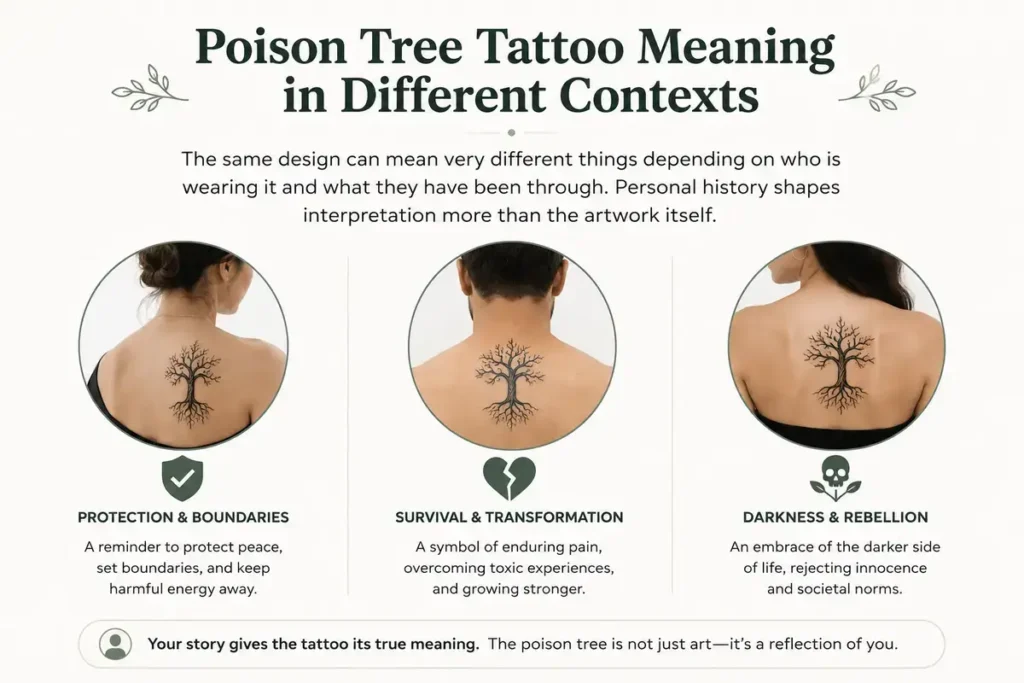
The same design can mean very different things depending on who is wearing it and what they have been through. Personal history shapes interpretation more than the artwork itself.
How the Meaning Shifts Across Different People
For women: Poison tree tattoo meaning for girl interpretations frequently connect to toxic relationships, emotional growth, or reclaiming strength after a difficult experience. The design often gets paired with softer elements like flowers or birds to balance the darker symbolism.
For men: Poison tree tattoo meaning for guys often leans toward resilience, betrayal, or a visual representation of overcoming a specific struggle. Bolder, more graphic styles tend to be common, with stronger contrast between the tree and its surroundings.
Mental health context: Poison tree tattoo meaning mental health interpretations usually focus on survival rather than the struggle itself. The tree becomes a marker of “I got through this,” chosen during or after recovery.
Symbolic strength: Poison tree tattoo meaning strength readings frame the design less around the harm and more around what the wearer carried through it. This interpretation is common among people who got the tattoo specifically to mark personal progress.
Aesthetic-first approach: Not everyone attaches deep personal meaning. Some people genuinely just like the visual style, dark trees, gothic linework, surreal botanical art, without assigning a specific story to it.
Poison Tree Tattoo Meaning Across Online Communities
While this tattoo is not the kind of thing that trends on every platform the way slang terms do, certain online spaces play a big role in how people learn about and discuss it.
Reddit: Poison tree tattoo meaning reddit threads are some of the most detailed sources of personal interpretation online. Tattoo-focused subreddits often feature people sharing photos alongside the story behind their design, which has helped shape collective understanding of the symbol over time.
Instagram: Tattoo artists frequently post poison tree designs in their portfolios, often with captions explaining the symbolism behind a specific commission. This platform is where a lot of design inspiration originates.
Pinterest: A major source for visual references. People searching for design ideas often save poison tree images without necessarily reading into the symbolism, though boards dedicated to “meaningful tattoos” often group this design alongside other symbolic trees.
TikTok: Tattoo reveal videos sometimes include poison tree designs, especially in videos focused on mental health journeys or relationship recovery, where the tattoo is shown alongside a short explanation.
Facebook and X: Less common for tattoo-specific discussion, though tattoo communities and groups on Facebook sometimes feature similar conversations to Reddit, just smaller in scale.
What People Think When They See This Tattoo
In social settings, a poison tree tattoo often sparks curiosity rather than assumptions. Most people read it as artistic and a little mysterious before they know the story behind it.
In dating or new social situations, this tattoo can actually serve as a natural conversation starter. It is visually distinct enough to prompt a question, but vague enough that the wearer controls how much they want to share.
How to Respond When Someone Asks About Your Poison Tree Tattoo
Two things worth deciding before answering:
- Do you want to share the real story, or keep it light?
- Is this someone you’re comfortable being open with?
If you want to keep it simple:
- “Just liked the design, honestly.”
- “It’s symbolic, but the short version is it represents growth.”
- “Long story, but basically it’s about getting through something hard.”
If you want to share more:
- “It represents a relationship I had to walk away from.”
- “It’s tied to my mental health journey, a reminder of how far I’ve come.”
- “It’s based on a poem about anger that grows if you don’t deal with it.”
When Should You Get a Poison Tree Tattoo in 2026
This design remains a strong choice for anyone drawn to symbolic, story-driven tattoo art. Consider it if:
- You have been through something difficult and want a permanent reminder of growth afterward.
- You are drawn to gothic, illustrative, or nature-based tattoo styles and want something with built-in symbolism.
- You want a tattoo that invites conversation without forcing you to explain everything upfront.
- You are looking for a design that can be expanded later into a larger, more personal piece.
- The contrast between beauty and danger genuinely resonates with how you see a chapter of your life.
When Not To Get a Poison Tree Tattoo
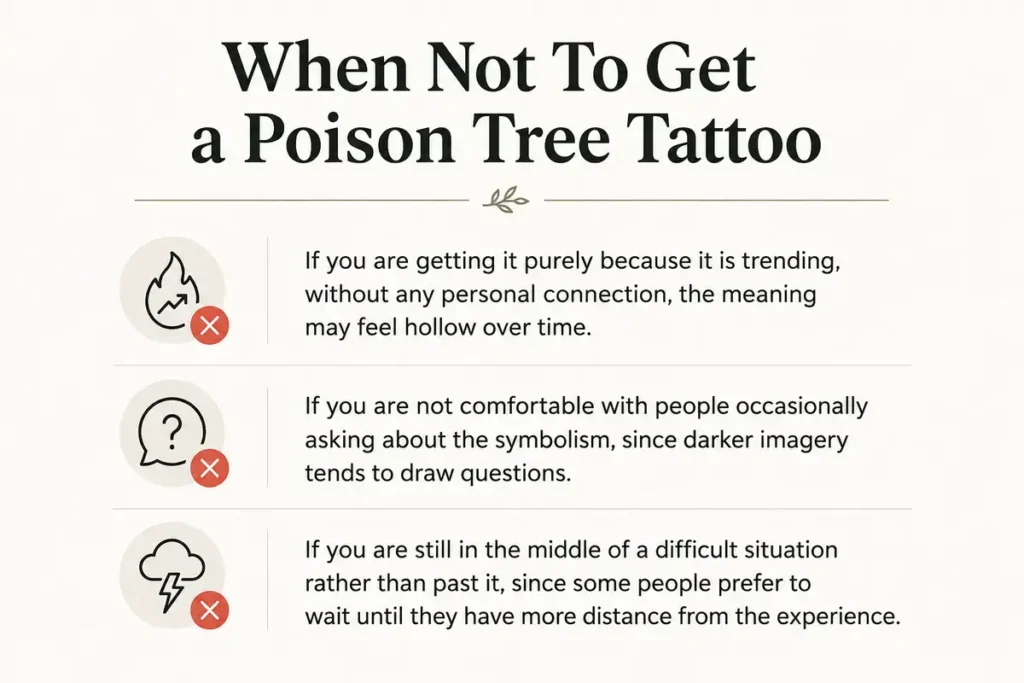
This design is not the right fit for everyone, and that is worth considering before booking an appointment.
- If you are getting it purely because it is trending, without any personal connection, the meaning may feel hollow over time.
- If you are not comfortable with people occasionally asking about the symbolism, since darker imagery tends to draw questions.
- If you are still in the middle of a difficult situation rather than past it, since some people prefer to wait until they have more distance from the experience.
- If the design style you are drawn to does not match the artist’s strengths, since this tattoo relies heavily on execution to land the contrast effectively.
- If you would rather choose a symbol with a single, fixed meaning rather than one that depends on personal interpretation.
Read this next: CYC Meaning in Text What It Means in 2026
Conclusion
Poison tree tattoo meaning ultimately comes down to one idea: things are not always what they look like on the surface. Whether that translates to a toxic relationship, a personal struggle, or a story of getting through something hard, the symbolism gives the design depth without requiring a single fixed interpretation.
From literary roots in Blake’s poetry to biblical echoes of forbidden fruit, this tattoo carries centuries of symbolic weight while still feeling personal to whoever wears it. Some choose it for the story, some for the aesthetic, and many for both.
If you are considering this design, the meaning is yours to shape. The tree provides the framework. What it represents is entirely up to the person wearing it.
FAQs
What does the poison tree symbolize?
The poison tree symbolizes hidden anger, resentment, and unresolved emotions. Instead of expressing feelings openly, a person lets them grow over time. As a result, that anger can become harmful to both themselves and others.
What does a Poison Tree tattoo mean?
A Poison Tree tattoo usually represents suppressed emotions, personal struggles, or the consequences of holding onto resentment. Additionally, many people choose this design to symbolize growth through difficult experiences and emotional healing.
Is an A Poison Tree tattoo bad?
No, an A Poison Tree tattoo is not inherently bad. Instead, its meaning depends on the wearer. While some people connect it to anger and betrayal, others view it as a reminder to express emotions honestly and avoid negativity.
What is the meaning behind the poison tree?
The poison tree often represents how unchecked anger can grow and create harmful outcomes. Therefore, it serves as a powerful symbol of emotional consequences, self reflection, and personal awareness.
What is the meaning behind an A Poison Tree tattoo?
An A Poison Tree tattoo draws inspiration from the poem A Poison Tree by William Blake. As a result, the tattoo commonly symbolizes hidden resentment, emotional growth, and the importance of dealing with conflicts in a healthy way.
Is the poison tree biblical?
No, A Poison Tree is not a biblical story. However, the poem contains themes that resemble biblical teachings about anger, forgiveness, temptation, and moral consequences. Consequently, many readers notice spiritual and religious symbolism within its message.

Riley Morgan explores internet slang, viral trends, and evolving online language. She helps readers stay up to date with the words and phrases shaping conversations across the web.
My pick for RomanticPuns.com would be Avery Brooks because it sounds professional, trustworthy, and fits slang meaning content naturally.