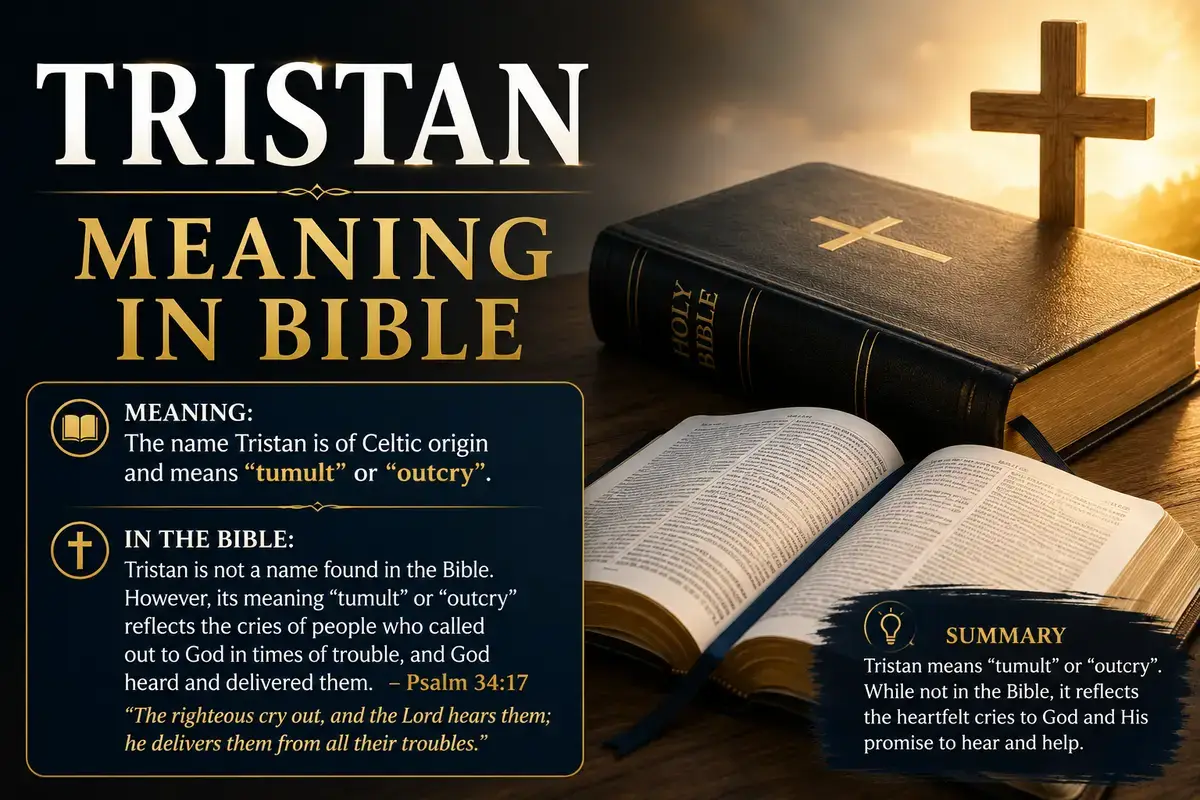
Tristan meaning in Bible is a question many people ask when choosing this name for a child or exploring its spiritual depth. The name doesn’t appear in Scripture directly, but the themes woven into its meaning, sorrow, struggle, endurance, and eventual restoration, echo through dozens of biblical narratives. That overlap makes it worth exploring carefully.
The name has Celtic and Old French roots, carrying meanings tied to sadness, tumult, and inner conflict. At first glance those sound like negatives. Look closer at Scripture though, and you’ll find that God consistently works through exactly those experiences. Sorrow is where He draws near. Struggle is where faith gets built.
People searching for the spiritual side of this name are often parents, believers, or people reflecting on what their own name means in a faith context. The answer isn’t that Tristan is a biblical name. Rather, it’s that the human experiences embedded in its meaning are deeply biblical.
This article covers the name’s origin, the biblical themes it connects with, relevant Scripture verses, and what the name can mean spiritually for someone who carries it in 2026.
Quick Definition: Tristan has no direct biblical mention, but its meaning connects to biblical themes of sorrow, trial, and redemption. Rooted in Old French and Celtic origins, the name spiritually symbolizes the journey from hardship to strength, a pattern found throughout Scripture.
Helpful post: Gleb Savchenko Age in 2026 Birthday, Career, and Net Worth
Tristan Meaning in Bible at a Glance
| Feature | Details |
|---|---|
| Name | Tristan |
| Part of Speech | Proper noun (personal name) |
| Core Meaning | Sorrow, tumult, noise, or conflict |
| Language of Origin | Old French (“triste”) and Celtic (“Drustan/Drostán”) |
| Biblical Presence | Not mentioned in Scripture directly |
| Spiritual Themes | Sorrow to strength, trials to trust, pain to purpose |
| Pronunciation | TRIS-tan |
| Context of Use | Christian name selection, spiritual reflection, name meaning research |
What Does Tristan Meaning in Bible Actually Mean?
Tristan does not appear anywhere in the Bible. That’s the honest, direct answer.
What does exist in Scripture, in remarkable depth, are the experiences the name represents. Sorrow. Conflict. Endurance under pressure. Redemption after loss. Those aren’t foreign to the Bible; they’re central to it.
The Old French root of Tristan is “triste,” meaning sad or sorrowful. Its Celtic ancestor, Drustan or Drostán, connects to words meaning tumult or noise, suggesting conflict and struggle. When you layer those meanings over Scripture, they land on familiar ground.
Consider a few biblical figures whose lives map directly onto this meaning:
- Joseph endured betrayal, slavery, and false imprisonment before rising to leadership in Egypt
- Job experienced total devastation before restoration
- David moved through years of grief, failure, and danger before his purpose was fully realized
- Hannah wept bitterly before her prayer was answered
- Naomi returned home broken before her story turned toward joy
None of these people were named Tristan. Every single one of them lived the meaning of it. That’s why the name carries genuine spiritual weight, even without a biblical citation to point to.
Deeper Meaning and Significance
The spiritual significance of this name lies not in a single definition but in a pattern. Biblical meaning often works this way: a name captures a human experience, and Scripture fills that experience with purpose.
Primary Tristan Meaning in Bible
The primary biblical connection is sorrow that leads to strength. Psalm 34:18 says God is close to the brokenhearted. That closeness isn’t passive. Throughout Scripture, sorrow functions as the starting point for some of the most significant transformations recorded.
Key biblical threads that mirror this meaning:
- Psalm 30:5: “Weeping may last through the night, but joy comes in the morning”
- Romans 5:3-4: Suffering produces perseverance, which produces character, which produces hope
- Isaiah 61:3: God gives a crown of beauty for ashes, joy instead of mourning
The primary spiritual reading of Tristan meaning in Bible is this: the sorrow in the name is not its destination. It’s where the story begins.
Secondary Tristan Meaning in Bible
The secondary layer is conflict and trial producing trust. The Celtic root meaning of tumult or struggle connects to the biblical understanding of testing. James 1:2-4 frames trials not as punishment but as the mechanism through which faith deepens.
Secondary spiritual themes include:
- Refinement: Proverbs 17:3 describes God refining hearts the way fire tests metal
- Dependence: 2 Corinthians 12:9 teaches that God’s power shows up most clearly in weakness
- Endurance: Hebrews 12:1 calls believers to run with endurance the race set before them
Taken together, the two layers give Tristan a complete spiritual arc: sorrow opens the door, trials build the character, and faith carries the person through to restoration.
Tristan Meaning in Bible: Origin and Etymology
Understanding where the name comes from historically helps clarify why it carries the spiritual weight it does.
Old French root: The most widely cited origin links Tristan to “triste,” the Old French word for sad or sorrowful. This root shaped how the name was perceived across medieval Europe and explains its consistent association with emotional depth and melancholy.
Celtic root: Scholars also trace the name to Drustan or Drostán, a Pictish and early Scottish name possibly derived from a word meaning riot, tumult, or noise. This version of the origin connects the name to conflict and upheaval rather than quiet sadness.
The legend of Tristan and Isolde: The medieval romance made the name famous across Europe. In the story, Tristan is a noble warrior caught in a tragic, forbidden love affair. The tale cemented the name’s association with heartbreak and emotional complexity. It’s worth noting this is a secular legend, not a Christian narrative, and it doesn’t define the name’s spiritual meaning.
Modern adoption: Today many parents choose Tristan for its sound and strength, often without awareness of its sorrowful etymology. In Christian households, the name is increasingly viewed through a redemptive lens, meaning that what started as sorrow can be reinterpreted as the beginning of a faith journey.
The name’s journey mirrors what Scripture says about hard things: they don’t stay only hard.
Examples of Tristan Meaning in Bible in Sentences
The name shows up in spiritual conversation in specific, recognizable ways. These examples reflect how people actually use and discuss it.
Tristan Meaning in Bible: Real-Life Clarity
- “We named our son Tristan because the idea of sorrow becoming strength felt deeply biblical to us, even though the name itself isn’t in Scripture.”
- “The Tristan meaning in Bible question is common; the name doesn’t appear there, but the emotional journey it represents absolutely does.”
- “Tristan symbolizes what Job went through: unimaginable difficulty followed by restoration.”
- “Our pastor explained it well: Tristan’s meaning in a biblical context is the same story God tells over and over, pain with a purpose.”
Tristan Meaning in Bible: Mean in Daily Life
In everyday spiritual conversation, the name comes up in contexts like:
- Parents explaining their name choice to grandparents or church communities
- Someone reflecting on their own name’s meaning during a difficult season
- Bible study discussions about names and their spiritual significance
- Christian baby name research comparing Tristan to more traditional biblical names
Related Terms People Search With Tristan Meaning in Bible
People researching this topic often arrive through related searches. Understanding these helps place the name in its proper context.
Synonyms and Related Concepts
| Search Term | What People Are Looking For |
|---|---|
| Biblical meaning of Tristan | Whether Scripture defines or validates the name |
| Tristan spiritual meaning | Faith-based interpretation of the name’s themes |
| Tristan name origin | Historical and linguistic roots |
| Christian names not in Bible | Wider category this name belongs to |
| Names meaning sorrow in Bible | Comparison names: Mara, Jabez, Ichabod |
| Names meaning strength | Contrast names that show the other side of the arc |
| Tristan and Isolde Christian meaning | Whether the legend has spiritual application |
The closest biblical names in terms of emotional meaning include Mara (bitter, Ruth 1:20), Jabez (pain, 1 Chronicles 4:9-10), and Gethsemane (oil press, associated with anguish). None are exact synonyms, but all share the same spiritual pattern: difficulty as a starting point, not a final word.
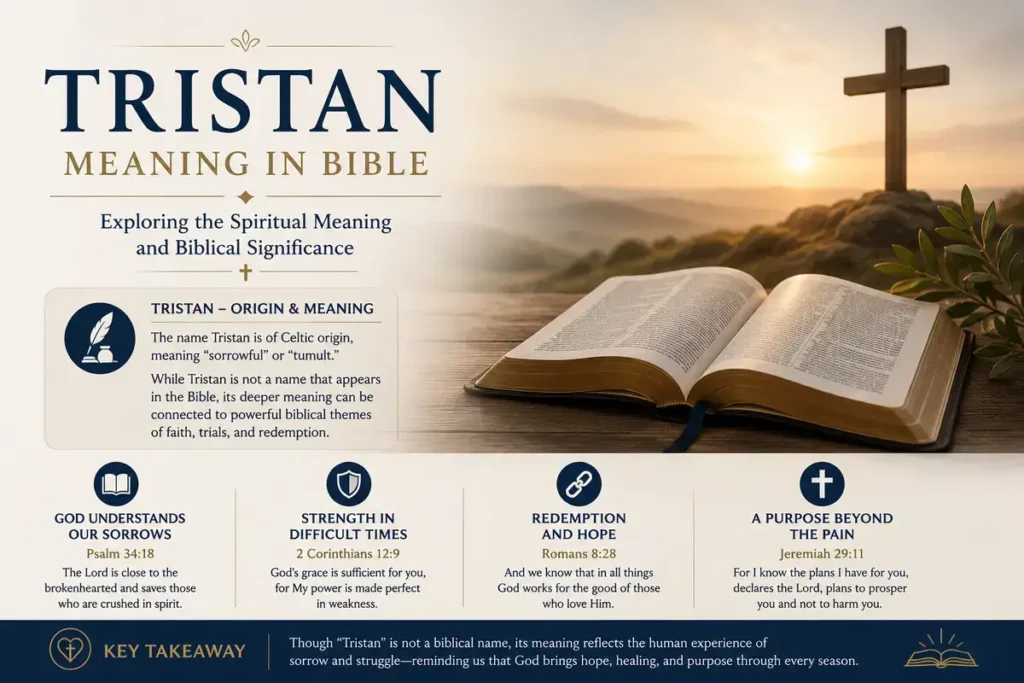
Tristan Meaning in Bible in Different Contexts
The name lands differently depending on who is asking and why. Context matters significantly here.
Tristan Meaning in Bible: Usage in Different Contexts
For parents choosing a name: The spiritual question is usually: can this name honor God even if it’s not in the Bible? The answer is yes. Many beloved Christian names (Monica, Patrick, Francis) have no biblical origin. What matters is the meaning carried and the faith behind the choice.
For adults reflecting on their own name: Someone named Tristan going through a difficult season might find genuine comfort in the idea that their name spiritually maps onto the journey from sorrow to restoration. That’s not forced; it’s a real interpretive tradition.
For Bible study or theological contexts: The name becomes a case study in how Christians engage with culture and language. Not every meaningful name needs a chapter and verse. Biblical themes exist outside biblical vocabulary.
For skeptical or academic readers: The honest position is straightforward: Tristan has no biblical citation. Its spiritual meaning is interpretive, not textual. That’s a legitimate kind of meaning, clearly labeled as such.
Tristan Meaning in Bible Across Social Media Platforms
Discussion of this name’s spiritual meaning shows up across platforms, each with its own flavor.
Facebook: Primarily in Christian parenting groups and name discussion communities. Parents ask whether the name is appropriate for a Christian family and receive a range of responses, most affirming it when the spiritual reinterpretation is explained.
Instagram: Shows up in aesthetic Christian content, name meaning posts, and faith-based motherhood accounts. The sorrow-to-strength arc makes for compelling visual storytelling.
TikTok: Name meaning content performs well here. Videos breaking down “what does Tristan mean spiritually” or “is Tristan a Christian name” pull strong engagement, especially from young parents.
X (Twitter): Occasional theological discussion threads, usually sparked by someone questioning whether non-biblical names belong in Christian households.
Pinterest: Popular for Christian baby name boards where Tristan appears alongside names like Elijah, Ezra, and Silas, even though it doesn’t share their biblical origin.
LinkedIn: Essentially absent. This is not a professional conversation.
Tristan Meaning in Bible in Online Dating and Social Conversations
In personal conversations, someone named Tristan who identifies as Christian sometimes gets asked whether the name has biblical roots. It’s a natural question in faith-based dating and social contexts.
Common scenarios:
- “My name is Tristan, it’s not in the Bible but my parents chose it for its spiritual symbolism.”
- Someone on a faith-based dating app explaining their name’s meaning as part of sharing their story
- Small group introductions where names and meanings are discussed
The name tends to prompt meaningful conversation rather than confusion once the spiritual context is given.
How to Respond When Someone Asks About Tristan Meaning in Bible
This comes up often enough to be worth addressing directly. If someone asks whether Tristan is biblical, the honest and confident answer is clear.
Two quick principles before responding:
- Be honest that the name isn’t in Scripture
- Offer the spiritual interpretation as its own valid form of meaning
If asked casually:
- “It’s not in the Bible, but the themes behind the name really are. Sorrow, trials, strength through hardship; that’s all over Scripture.”
- “The name means something like sadness or struggle, which sounds heavy until you see how often God works through exactly that.”
If asked in a faith context:
- “It carries a biblical pattern even without a biblical citation. Think of Joseph or Job; the name fits that arc.”
- “We chose it because of what it symbolizes spiritually, not because it’s in a chapter and verse.”
When Should You Use Tristan Meaning in Bible in 2026
This framing is useful in specific, genuine situations:
- When choosing a name for a child and wanting to understand its spiritual dimensions
- When writing or speaking about Christian name theology and whether names must be biblical to carry spiritual weight
- When helping someone named Tristan understand or reclaim their name’s meaning in a faith context
- When producing content for Christian parenting, theology, or name meaning audiences
- When leading discussions about how Christians engage with culture, language, and meaning outside of Scripture
The conversation around non-biblical Christian names is growing in 2026, particularly among younger parents who want names that feel modern but carry spiritual depth.
When Not to Use Tristan Meaning in Bible
A few situations where this framing doesn’t work:
- Don’t claim Tristan appears in Scripture. It doesn’t, and stating otherwise damages credibility with informed readers and Google’s quality systems
- Don’t present the spiritual meaning as textual meaning. The connection is interpretive and symbolic; be clear about that distinction
- Don’t use it to argue all names carry biblical meaning. Some names simply don’t connect meaningfully to Scripture, and overstating the case weakens the argument for names like Tristan that do have genuine thematic overlap
- Don’t position it as equivalent to names like Elijah, Ezra, or Noah. Those names carry explicit scriptural weight. Tristan carries spiritual resonance through theme, not text, and that difference matters
Read this next: Ella Knox Age in 2026 Birthday Bio Career and Net Worth
Conclusion
Tristan meaning in Bible comes down to this: the name itself isn’t there, but everything the name represents is. Sorrow, conflict, endurance, and the long journey toward restoration are not peripheral biblical themes. They sit at the center of the stories Scripture tells most often.
A name doesn’t need a citation to carry spiritual meaning. It needs a connection to truth, and Tristan has one. The same God who drew near to Job in his suffering, who redeemed Joseph’s pain, who turned Naomi’s bitterness toward joy, is the same God who can fill a name like Tristan with purpose and hope.
For Christians navigating this question, the answer is generous: carry the name with confidence. The story it tells is a biblical one, even if the word itself never appears on the page.
FAQs
What does the name Tristan mean in Christianity?
The name Tristan does not have a specific biblical or Christian meaning. It is commonly associated with medieval legends and is often linked to themes of loyalty, courage, and romance.
Is the name Tristan good?
Yes, Tristan is a popular and well-regarded name known for its strong sound, timeless appeal, and rich literary history.
What does Tristan symbolize?
Tristan often symbolizes love, bravery, devotion, and adventure due to its connection with the legendary tale of Tristan and Isolde.
What is the meaning of Tristan?
The name Tristan is believed to have Celtic origins and is commonly associated with meanings such as “bold,” “tumult,” or “sorrowful,” depending on its historical interpretation.
What’s a good nickname for Tristan?
Popular nicknames for Tristan include Tris, Tristy, T, Stan, and Trix. The best nickname often depends on personal preference and personality.
Does Tristan mean love?
Tristan does not directly mean “love.” However, the name is strongly associated with romance because of the famous medieval love story of Tristan and Isolde.

I’m Daniel from Austin Texas and I believe every great love story deserves a punchline. I write puns that feel warm silly and just a little flirty because romance should never be boring. When I’m not writing I’m on road trips collecting inspiration and bad ideas that somehow turn into good jokes.