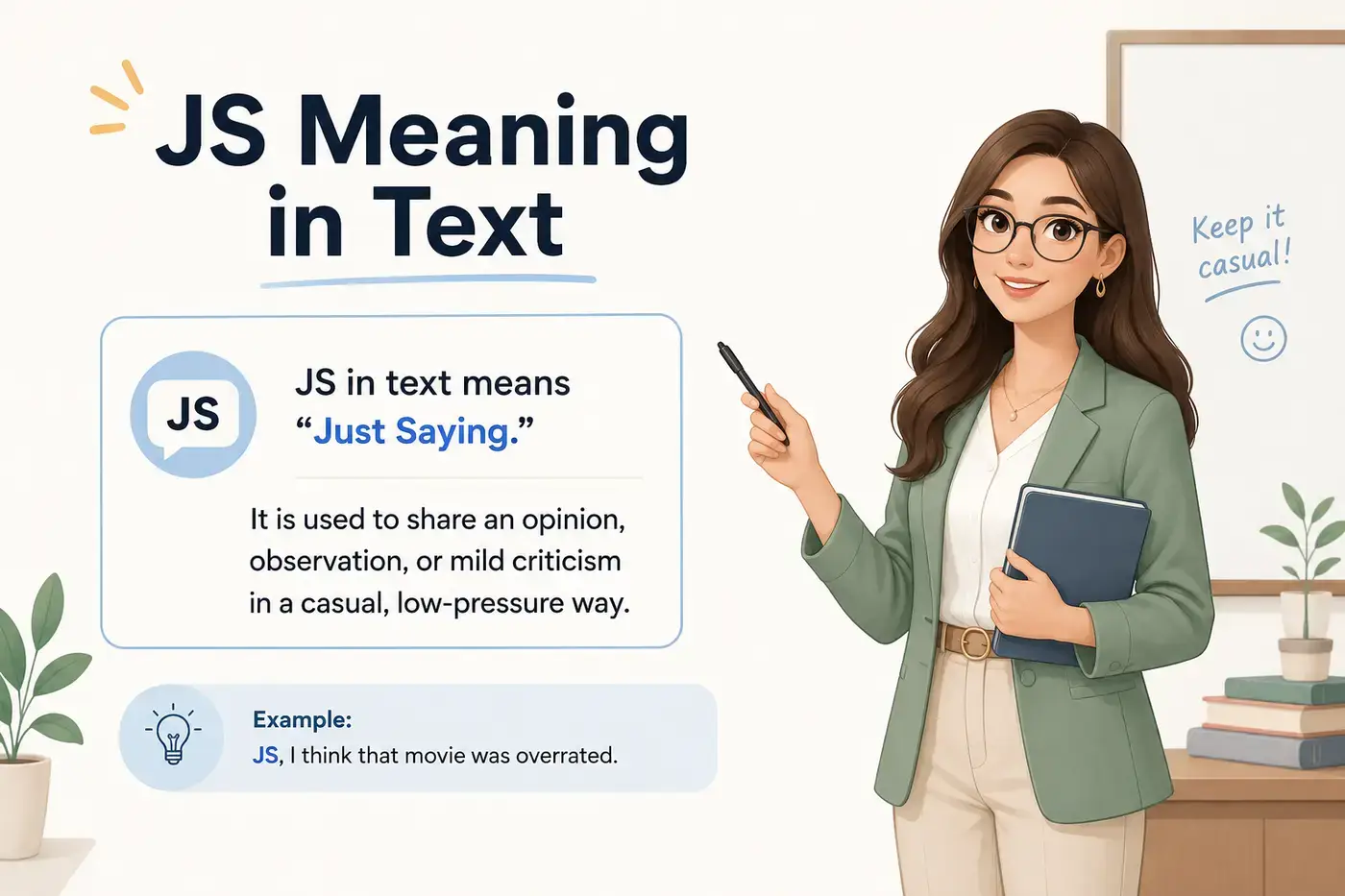
JS meaning in text is “Just Saying,” a casual phrase people attach to opinions, observations, or mild criticism when they want to soften the delivery without taking back what they said. It is the digital equivalent of shrugging after making a point. Three characters, but the tone behind them can range from playful to passive-aggressive depending on the conversation.
The phrase “just saying” has been part of everyday spoken English for decades. Online, it got compressed into JS and found a comfortable home in texting, TikTok captions, Instagram comments, and group chats. People use it to flag that what they said is their honest take, not a formal accusation or argument opener.
What trips people up is that JS sits in a gray area emotionally. Used between close friends, it reads as light and self-aware. Dropped at the end of a pointed observation in a tense conversation, it lands very differently. Context and relationship determine which version you are dealing with.
Understanding JS meaning in text properly means knowing not just the definition but the emotional range it covers and when each version is likely to appear.
Quick Definition: JS in text means “Just Saying.” It is used to share an opinion, observation, or mild criticism in a casual, low-pressure way. Common in texting, TikTok, Instagram, and group chats. Often appears at the end of a sentence to soften a direct statement without retracting it.
Read this next: IDC Meaning In Text Explained With Examples And Usage
JS Meaning in Text at a Glance
| Feature | Details |
|---|---|
| Full Form | Just Saying |
| Part of Speech | Phrase (used as a discourse marker or interjection) |
| Definition | Signals a casual opinion or observation the sender stands by |
| Language of Origin | American English, adapted from spoken slang |
| Context of Use | Texting, TikTok, Instagram, group chats, Twitter/X |
| Pronunciation | Spelled out: J-S |
What Does JS Mean in Text?
JS stands for “Just Saying.” At its core, it is a verbal disclaimer people attach to honest opinions they want to share without starting a fight about it.
The spoken version, “just saying,” is something people add when they know what they said might land hard. JS in text does the same job. It signals: this is my genuine take, I am not apologizing for it, but I am also not trying to escalate.
Does JS mean just in text? Yes, specifically “just saying” rather than the word “just” alone. That distinction matters because the phrase carries its own specific social function. Saying “js” is not the same as writing “just” in the middle of a sentence. It is always the full phrase compressed.
Deeper Meaning and Significance
JS has more emotional range than most two-letter abbreviations. Where it lands in a conversation determines whether it reads as playful, honest, or pointed.
Primary JS Meaning in Text
The primary use is a friendly, low-stakes way to share an opinion or observation. This version of JS is self-aware and casual. The person knows they are being a little blunt but is not being mean about it.
Examples:
- “That outfit was not it, js.”
- “You could’ve texted back sooner, js.”
- “The movie was overhyped, js.”
- “That restaurant is way overpriced, js.”
In these cases, JS softens the delivery just enough. The sender stands by their opinion but signals they are not trying to pick a fight over it.
Secondary JS Meaning in Text
The secondary use is more charged. Here JS functions as a passive-aggressive closer, the sender says something pointed and then shields themselves from the response with “just saying.” This is the version that causes friction.
Examples:
- “You never really put in effort, js.”
- “Other people actually show up for their friends, js.”
- “It is giving exactly what everyone expected, js.”
JS meaning in text from a guy in this context often reads as indirect confrontation, a way of saying something critical without owning it fully. The same pattern applies regardless of gender, but the abbreviation gives the sender plausible deniability which is exactly what makes this version more complex to navigate.
Origin and Etymology
The phrase “just saying” has roots in American conversational English and was well established in spoken language long before texting existed. People used it to soften bold opinions in face-to-face conversation, the same social function it serves digitally today.
As SMS messaging became dominant in the early 2000s, common spoken phrases got abbreviated. “Just saying” compressed into JS naturally, following the same pattern as “to be honest” becoming tbh and “not gonna lie” becoming ngl.
By the mid-2010s, JS was appearing regularly across Twitter and early Instagram, often at the end of opinion-heavy posts. JS meaning in TikTok usage expanded that further, with creators dropping “js” in captions and comments to signal they are sharing a hot take without committing to a full argument.
TS meaning in text is a related term worth knowing: it typically stands for “This S**t” or “That Said” depending on context, and sometimes gets confused with JS in fast-moving conversations. They are different abbreviations with different functions.
JS Meaning in Text: Examples in Sentences
Seeing JS across different emotional registers makes its range immediately clear. The abbreviation does different things in different mouths.
Real-Life Clarity
Everyday, low-stakes usage:
- “That show gets better after episode three, js.”
- “You would probably enjoy it if you gave it a chance, js.”
- “The coffee here is actually better than that fancy place, js.”
- “She handles that better than most people would, js.”
- “Earlier would have been easier for everyone, js.”
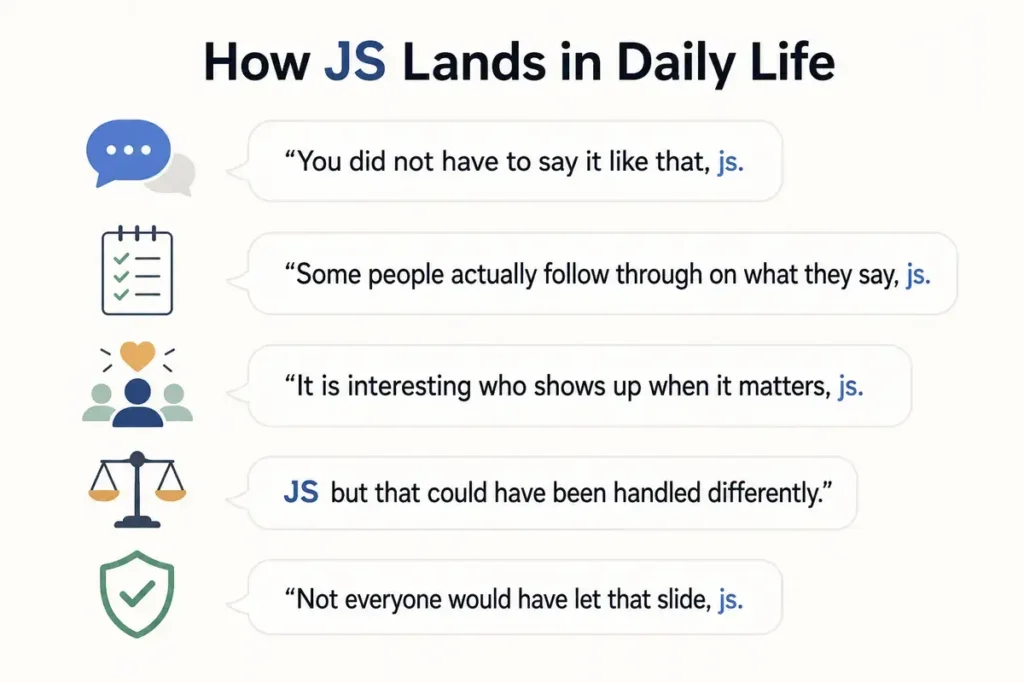
How JS Lands in Daily Life
More charged or personal usage:
- “You did not have to say it like that, js.”
- “Some people actually follow through on what they say, js.”
- “It is interesting who shows up when it matters, js.”
- “JS but that could have been handled differently.”
- “Not everyone would have let that slide, js.”
Related Slang People Search Alongside JS
JS belongs to a wider family of opinion-signaling abbreviations that all do slightly different versions of the same job.
Synonyms and Related Terms
| Term | What It Means |
|---|---|
| TBH | To Be Honest (shares an opinion with a sincerity signal) |
| NGL | Not Gonna Lie (similar candor marker, slightly more vulnerable) |
| IMO / IMHO | In My Opinion / In My Humble Opinion (explicit opinion flagging) |
| FR | For Real (emphasizes sincerity rather than softening) |
| JK | Just Kidding (the opposite move: walks back what was said) |
| TS | This/That Said (transition phrase, different function to JS) |
JS sits closest to TBH in everyday use, but TBH leans into honesty as a value while JS leans into casualness as a shield. The difference is subtle but real in how each one lands.
How Context Changes Everything
JS reads completely differently depending on platform, relationship, and what the rest of the message says. Two sentences using JS identically can communicate opposite things.
Usage in Different Contexts
Group chats: Usually playful and low stakes. Friends use JS to share opinions about shared experiences without any real tension behind it. “That was chaotic, js” in a group chat after a night out is just commentary, not a complaint.
Relationship conversations: JS meaning in relationship contexts can be a red flag depending on delivery. Healthy usage sounds like honest, gentle feedback. Unhealthy usage is indirect criticism wrapped in a casual closer. “You could try harder, js” in a relationship conversation is not really casual at all.
School and academic settings: JS meaning in school tends to be lighter. Students use it in group chats, class group messages, and between friends commenting on assignments, teachers, or school events. “That exam was brutal, js” is just venting.
Professional environments: JS has no place in professional communication. Even in casual workplace Slack channels, it reads as flippant or passive-aggressive depending on the message it closes.
Spanish-speaking and bilingual communities: JS meaning in text Spanish-language contexts refers to the same “just saying” meaning, used by bilingual users who mix English abbreviations into Spanish conversations. It is part of the broader Spanglish digital vocabulary common in American Latino communities online.
JS Across Social Media Platforms
Facebook: Appears mostly in comments and Messenger. Older users may not recognize it, so it is more common among millennial and younger users on the platform.
Instagram: JS meaning in Instagram posts and comments is common, especially under opinion-heavy content. Creators drop “js” in captions when sharing takes they know are divisive. In DMs, it softens direct observations between mutuals.
TikTok: Very active. JS meaning in TikTok spans captions, comment sections, and spoken dialogue in videos. It is a staple of opinion content and reaction videos where the creator shares a take and closes with “js” to signal they are not looking for a debate.
X (Twitter): Common in replies and quote posts. Twitter’s confrontational culture means JS sometimes reads as more pointed there than on other platforms. Context still rules, but assume a slightly sharper edge.
Snapchat: Used casually between friends in conversations and snap captions. Low stakes, relaxed, usually in its friendlier form.
LinkedIn: Not appropriate. If someone uses JS on LinkedIn, they have misjudged their audience significantly.
JS in Online Dating and Relationships
In dating conversations, JS carries specific weight. Someone using JS in a flirtatious exchange is usually being playfully direct. “You are kind of hard to read, js” is a soft opener for a more honest conversation.
JS meaning in relationship dynamics gets more complex. Partners sometimes use it to deliver feedback they are uncomfortable stating plainly. “You take forever to reply, js” sounds casual but usually means the issue matters more than the delivery suggests.
JS meaning in text from a guy in a dating or relationship context often signals he has an opinion he is hedging on. Whether it is playful or passive-aggressive depends on whether the conversation around it is warm or tense.
Replying When Someone Sends JS
How you respond to JS depends on reading the room before you type anything back.
Two things to figure out first:
- Is the message genuinely low-stakes or is there tension underneath it?
- Does the sender want a reaction or just acknowledgment?
Agreeing and keeping it light:
- “Lol fair enough, js back at you.”
- “Okay but you are right though.”
- “No you are completely correct, js.”
Pushing back calmly:
- “Noted, but I see it differently.”
- “Fair take, here is my side of it though.”
Deflecting without escalating:
- “Lol okay js.”
- “Received.”
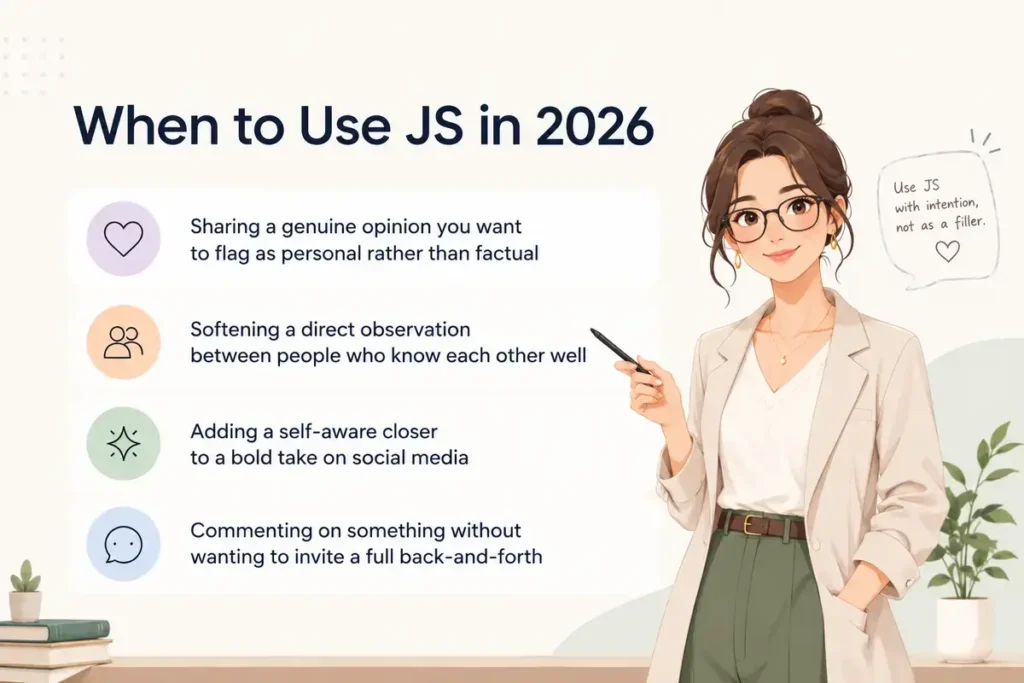
When to Use JS in 2026
JS is active across every major platform and not going anywhere. Reach for it when:
- Sharing a genuine opinion you want to flag as personal rather than factual
- Softening a direct observation between people who know each other well
- Adding a self-aware closer to a bold take on social media
- Commenting on something without wanting to invite a full back-and-forth
- Keeping a message honest without making it feel like a confrontation
- Writing a TikTok caption or Instagram comment that needs a casual, low-pressure closer
When Not to Use JS
JS has clear limits and real costs when used in the wrong place.
- Avoid it in professional messages, emails, or any work communication regardless of how casual the relationship feels
- Do not use it to deliver genuinely hurtful criticism and then claim casualness as a defense
- Skip it with people who do not know the abbreviation since it will read as a typo or error
- Do not use it repeatedly in the same conversation since it loses impact and starts to read as a verbal tic
- Avoid it in serious emotional conversations where clarity and directness matter more than a soft landing
Related article: What Is Saroo Brierley Net Worth in 2026?
Conclusion
JS meaning in text covers more ground than two letters should. At its best, it is a self-aware, honest way to share an opinion without forcing a confrontation. At its most complicated, it is a passive-aggressive shield that lets someone say something pointed while maintaining plausible deniability.
Across TikTok captions, Instagram comments, relationship texts, and group chats, JS has proven durable because it reflects something real about how people communicate: sometimes you want to say what you think without making it a whole thing. JS is how you do that in text form.
Now that you know what it means and how it operates, reading the intent behind it becomes a lot easier.
FAQs About JS Meaning in Text
What is JS in internet slang?
In internet slang, JS usually means “just saying.” People use it to share an opinion, suggestion, or observation without sounding too serious.
What do you mean by JS?
JS most commonly stands for “just saying.” It is often added at the end of a message to emphasize a point or casual opinion.
What did JS mean?
The meaning of JS depends on the context, but in texting and social media it most often means “just saying.” In technology, it can also refer to the programming language JavaScript.
What does JS stand for on Snapchat?
On Snapchat, JS typically stands for “just saying.” Users add it to messages when sharing a thought, opinion, or comment in a casual way.
What does JS mean in Gen Z slang?
In Gen Z slang, JS usually means “just saying.” It is commonly used in texts, social media posts, and chats to add emphasis to a statement.
What is JS in chat?
In online chat, JS generally means “just saying.” It is a shorthand expression used to make a point, offer feedback, or share an opinion informally.

I’m Ethan from California and I’ve been in love with wordplay since my first cheesy pickup line in middle school. I write romantic puns because nothing melts hearts faster than a groan followed by a smile. When I’m not crafting love jokes, I’m wandering West Coast coffee shops pretending I’m in a rom-com.