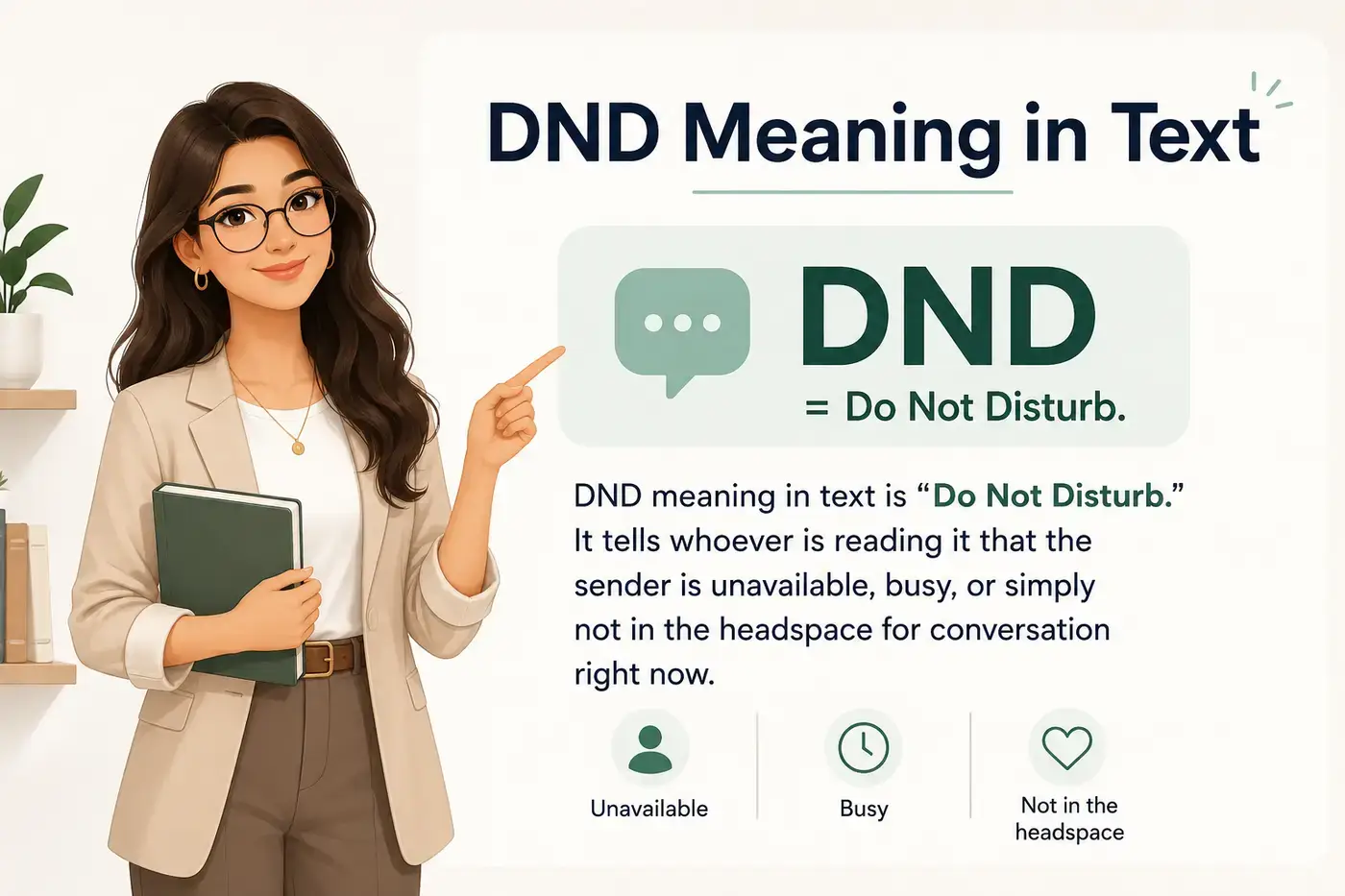
DND meaning in text is “Do Not Disturb.” It tells whoever is reading it that the sender is unavailable, busy, or simply not in the headspace for conversation right now. Three letters that set a boundary without requiring any explanation or apology attached.
The term has two lives running in parallel. On your phone, DND is a built-in feature that silences notifications. In casual conversation and texting, it works as a personal signal: I am offline by choice, not by accident. Both meanings are in active use, and most people switch between them without even thinking about it.
Context shifts the tone considerably. Someone saying “I’m on dnd” in a group chat sounds straightforward and neutral. Getting a one-word “dnd” reply after reaching out to someone you care about lands with a bit more weight. Understanding which version of DND you are dealing with changes how you respond.
Reading the energy behind DND meaning in text matters more than the abbreviation itself, because the same three letters can mean anything from “I am studying” to “I need space right now.”
Quick Definition: DND in text means “Do Not Disturb.” It signals that someone is unavailable, busy, or intentionally stepping away from their phone or social media. Used across texting, Snapchat, Instagram, and TikTok to set boundaries or explain a temporary absence from conversation.
Helpful post: BB Meaning in Text Everything You Need to Know in 2026
DND Meaning in Text at a Glance
| Feature | Details |
|---|---|
| Full Form | Do Not Disturb |
| Part of Speech | Phrase (used as a verb, noun, or status marker) |
| Definition | Signals unavailability or a request not to be contacted |
| Language of Origin | American English, borrowed from hospitality and phone settings |
| Context of Use | Texting, Snapchat, Instagram, TikTok, phone settings, group chats |
| Pronunciation | Spelled out: D-N-D |
What Does DND Meaning in Text Actually Mean?
DND stands for “Do Not Disturb.” In a texting context, it means the person is not available to respond, is actively ignoring notifications, or wants to be left alone for a while.
What does DND mean on phone specifically? Most smartphones have a built-in Do Not Disturb mode that mutes calls, texts, and app notifications. When someone says “I have dnd on,” they are often referring to this phone feature directly, meaning their phone is literally silenced and they may not see your message for a while.
In casual slang, DND goes a step further. People use it proactively to explain their silence before it becomes an issue, or reactively when someone asks why they have not responded. It is less about the phone setting and more about a personal state of unavailability.
DND meaning in text also overlaps with DND meaning game territory for a completely different group of people. Dungeons and Dragons players use the same abbreviation to refer to the tabletop role-playing game. Context makes it obvious which meaning applies in any given conversation.
Deeper Meaning and Significance
DND packs more social information into three letters than most abbreviations manage. The meaning shifts subtly based on relationship, platform, and tone.
Primary DND Meaning in Text
The primary meaning is a straightforward status update: the person is not available and does not want to be contacted right now. No emotional charge attached, no drama implied.
Examples where this primary meaning applies:
- “Gonna be on dnd for the next few hours, in a meeting.”
- “Dnd tonight, early morning tomorrow.”
- “On dnd, will reply when I’m back.”
- “Put my phone on dnd, trying to focus.”
- “Sorry for the late reply, had dnd on all day.”
This version of DND is purely functional. The sender is managing their time or attention and giving you a heads-up so you do not read anything into the silence.
Secondary DND Meaning in Text
The secondary meaning carries more emotional weight. Used in personal conversations, DND can signal that someone needs space, is emotionally overwhelmed, or is deliberately stepping back from social interaction.
DND meaning in love conversations tends to fall here. When someone you are dating says “I’m going on dnd for a bit,” it can mean they need time to think, are feeling overwhelmed, or simply need a break from being constantly reachable. Reading it as anger or rejection before checking in calmly is usually the wrong move.
DND meaning in text funny examples also live in this secondary space: the self-aware, slightly dramatic use of DND to signal that something minor annoyed you enough to go radio silent:
- “My family group chat will not stop so I’m on dnd, goodbye.”
- “He said what?? Dnd activated immediately.”
- “Going on dnd, the internet is too much today.”
These are relatable, humorous uses of the abbreviation where the underlying emotion is real but delivered with a light touch.
DND Meaning in Text: Origin and Etymology
The phrase “Do Not Disturb” predates the internet by decades. Hotels used it on door signs to signal that guests did not want housekeeping. The same principle carried over into office culture, where “do not disturb” on a closed door meant someone was in a meeting or needed to concentrate.
Technology borrowed the phrase directly. Phone operating systems built DND modes into their notification settings in the early 2010s, giving the term a second life in a completely new context. Apple introduced it in iOS 6 in 2012. Android followed shortly after. Almost overnight, “DND” became part of how people described their phone behavior.
From there it jumped into texting slang naturally. People were already talking about their DND settings in messages, and eventually the abbreviation detached from the phone feature and became a general-purpose signal for unavailability.
DND meaning in text Spanish speakers also use the abbreviation, particularly in bilingual communities in the US, though the Spanish equivalent is more commonly “No Molestar.” In English-dominant digital spaces, DND crosses language lines and gets used as-is.
Worth clarifying one overlap: DND meaning game refers to Dungeons and Dragons, a completely unrelated usage. If someone says “I’m busy with dnd on Saturday,” they might mean the game. If they say “I’m on dnd,” they mean Do Not Disturb. Sentence structure makes the difference clear.
Examples of DND Meaning in Text in Sentences
Seeing DND across different sentence types shows how naturally it fits into everyday digital conversation.
DND Meaning in Text: Real-Life Clarity
Functional, informational usage in real conversations:
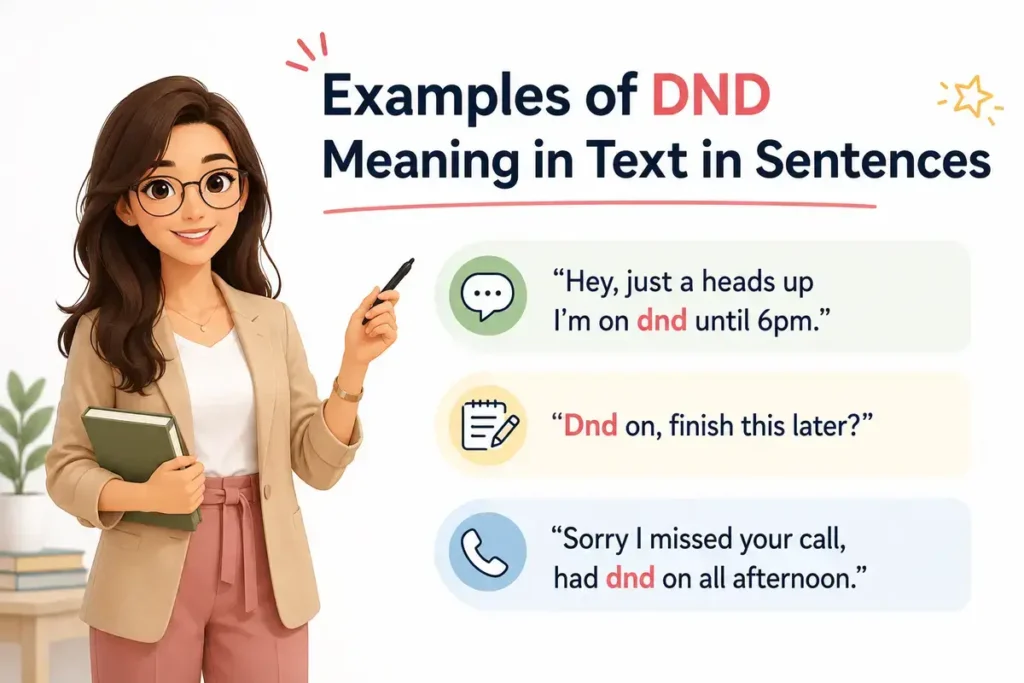
- “Hey, just a heads up I’m on dnd until 6pm.”
- “Dnd on, finish this later?”
- “Sorry I missed your call, had dnd on all afternoon.”
- “Turning dnd on for the weekend, need a proper break.”
- “Dnd meaning in text is literally just me every Sunday morning.”
DND Mean in Daily Life
How DND shows up in wider everyday digital life:
- Group chat explanation: “Going on dnd, this chat is giving me anxiety lol.”
- Social media status: posting a Story that says “on dnd, talk later.”
- Relationship check-in: “I know I’ve been on dnd a lot lately, just processing some things.”
- Work context: “Setting dnd from 9 to 12 so I can actually get things done.”
- Casual excuse: “Missed like 47 notifications, dnd strikes again.”
Related Slang Terms People Search With DND Meaning in Text
DND belongs to a family of digital boundary-setting terms. Knowing the related vocabulary helps you understand the full landscape it lives in.
Synonyms of DND Meaning in Text
| Term | What It Means |
|---|---|
| AFK | Away From Keyboard; temporarily unavailable online |
| BRB | Be Right Back; short-term absence |
| GTG | Got To Go; leaving the conversation now |
| OOO | Out Of Office; unavailable, usually work-related |
| NRN | No Reply Necessary; low-pressure, no response needed |
| Going dark | Informal phrase for stepping away from all communication |
DND is the most assertive of this group. AFK is passive. BRB implies a quick return. DND carries a firmer signal: do not expect a response, and do not try to push through the silence.
DND Meaning in Text in Different Contexts
Three letters, several different situations. The meaning stays the same but the implications shift depending on where DND shows up.
DND Meaning in Text: Usage in Different Contexts
Personal texting: The most common context. Someone explains their silence or sets expectations before going offline. Low stakes, practical communication.
Romantic relationships: DND meaning in love contexts requires more careful reading. A partner who consistently uses DND during specific times may be setting healthy boundaries. Used suddenly after a conflict, it can feel like emotional withdrawal. Asking calmly rather than assuming is always the better approach.
Group chats: Used to announce temporary disengagement from a chaotic or high-volume chat. Often accompanied by a lighthearted remark to soften the exit.
Work communication: DND in work messaging apps like Slack signals focused work time. Most professionals respect it in this context without question.
Gaming: When someone in a gaming group says “going dnd,” they likely mean Do Not Disturb from real-life interruptions so they can focus on a session, not Dungeons and Dragons specifically. Again, context makes the meaning obvious.
Spanish-speaking digital spaces: DND meaning in text Spanish usage appears in bilingual communities where the English abbreviation is understood. In fully Spanish conversations the phrase “no molestar” or the abbreviation “NM” would be more natural, but DND crosses over comfortably.
DND Meaning Across Social Media Platforms
Platform shapes how DND gets used and how it reads to the people who see it.
Facebook: Used mostly in Messenger. When someone says they have DND on via a status or message, it is usually genuine and practical. Older demographics are more likely to write it out fully rather than abbreviate.
Instagram: DND meaning in Instagram contexts shows up in DMs and Story replies. People post Stories explicitly saying they are on DND, which functions as a public announcement of unavailability to everyone following them at once.
TikTok: What does DND mean on TikTok? The same thing as everywhere else, but TikTok content adds a performative layer. Videos about going on DND, turning off notifications, or protecting your peace are a whole genre on the platform. The comment sections of those videos are full of people using “dnd” casually as a reaction or agreement.
Snapchat: What does DND mean on Snapchat? Snapchat has its own notification settings, and users reference DND frequently when explaining why they left a snap unopened or did not respond to a streak. “Sorry had dnd on” is a standard Snapchat explanation.
X (Twitter): Used in tweets about digital wellbeing, mental health breaks, or simply being offline. “Going on dnd, see you on the other side” type posts are common and relatable.
LinkedIn: DND appears here mostly in its professional form: Out of Office messages, status settings, or posts about disconnecting from work. Less abbreviation, more written out.
DND Meaning in Online Dating and Social Conversations
In dating app conversations and early relationship texting, DND sends a message that goes beyond logistics. Someone who drops “going on dnd” mid-conversation is setting a boundary, intentionally or not.
DND meaning in love situations often comes down to pattern recognition. Occasional DND use is healthy and normal. Consistent DND specifically when certain topics come up or when one person tries to get closer deserves a calm, direct conversation rather than assumptions.
Examples from dating contexts:
- “I tend to go on dnd after 10pm, just so you know upfront.” (healthy boundary-setting)
- “On dnd rn but I’ll reply in the morning.” (low pressure, considerate)
- “Dnd.” (sent abruptly with no context mid-conversation, worth gently following up on)
How to Reply When Someone Uses DND Meaning in Text
Replying to a DND message does not need to be complicated. The key is to read the context first and then respond proportionally.
Two things to settle before replying:
- Is this a practical heads-up or an emotionally loaded message?
- Does this person seem fine, or does something feel off?
Replying to a practical DND:
- “No worries, talk later.”
- “Got it, take your time.”
- “Okay! Reach out when you are back.”
Replying to an emotionally ambiguous DND:
- “Of course, hope you get the break you need.”
- “Take all the time you need, I am here when you are ready.”
- “No rush at all, just let me know when you are good.”
When not to reply: Sometimes the most respectful response to a DND message is no response at all. Sending multiple follow-up messages to someone who has just announced they are unavailable defeats the entire purpose of what they communicated.
When Should You Use DND in 2026
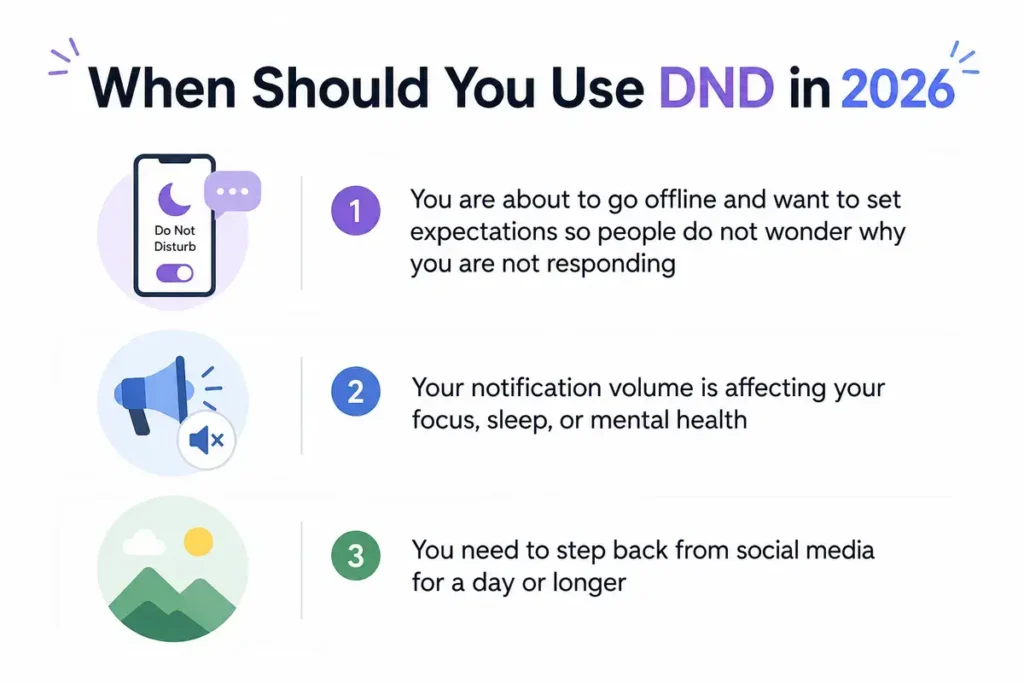
DND remains completely standard in 2026 across every major messaging platform and age group. Use it when:
- You are about to go offline and want to set expectations so people do not wonder why you are not responding
- Your notification volume is affecting your focus, sleep, or mental health
- You need to step back from social media for a day or longer
- You are in a context, like a meeting, exam, or important event, where you genuinely cannot respond
- You want to protect focused time without feeling guilty about not being available
- You are having a hard day and need space without owing anyone a detailed explanation
DND is one of the healthiest abbreviations in the digital vocabulary precisely because it communicates a boundary directly without drama.
When Not to Use DND
DND has real limits and using it carelessly creates misunderstandings.
- Do not use it mid-conversation without any context if the other person is dealing with something urgent or emotionally significant
- Avoid it as a passive-aggressive move in a conflict, where it reads as stonewalling rather than genuine disengagement
- Do not use it in professional settings where timely communication is expected and disappearing without notice creates problems
- Skip it as a permanent state in relationships where consistent unavailability is already a point of tension
- Do not use it to avoid difficult conversations indefinitely: a break is fine, but DND should not become a long-term avoidance strategy
Helpful post: CYC Meaning in Text What It Means in 2026
Conclusion
DND meaning in text comes down to one simple idea: I am not available right now. Whether someone has their phone on Do Not Disturb, needs a mental health break from notifications, or is signaling that they need space in a relationship, the abbreviation does the job cleanly and without excess explanation.
From what does DND mean on Snapchat to DND meaning in love conversations to the TikTok culture of protecting your peace, this three-letter abbreviation has embedded itself across every corner of digital communication in 2026. Knowing what it means is the easy part. Reading the context around it is where the real communication happens.
When someone sends you DND, give them the space they asked for. That is usually all they need.
FAQs
What does DND mean in text slang?
In text slang, DND usually stands for “Do Not Disturb.” It means someone does not want to be interrupted by calls, messages, or notifications.
What does DND slang mean?
DND is a common slang abbreviation for “Do Not Disturb.” People use it in texts, chats, and social media to indicate they are busy, resting, studying, or unavailable.
What does DND stand for in social media?
On social media, DND typically stands for “Do Not Disturb.” It can refer to a status, mode, or message letting others know that replies may be delayed.
What does DND mean in Gen Z?
Among Gen Z users, DND usually means “Do Not Disturb.” It is often used to signal a need for privacy, focus time, sleep, or a break from notifications.
What does DND mean for girls?
For girls, DND generally has the same meaning as for everyone else: “Do Not Disturb.” It indicates that a person is busy, unavailable, or prefers not to be contacted at the moment.
What is DND in Snapchat?
On Snapchat, DND stands for “Do Not Disturb,” a feature that lets users mute notifications from specific friends or groups without blocking them. This allows messages to be received silently while keeping conversations active.

I’m Daniel from Austin Texas and I believe every great love story deserves a punchline. I write puns that feel warm silly and just a little flirty because romance should never be boring. When I’m not writing I’m on road trips collecting inspiration and bad ideas that somehow turn into good jokes.